Echoes of the past: Golden-lustre ceramic bowl
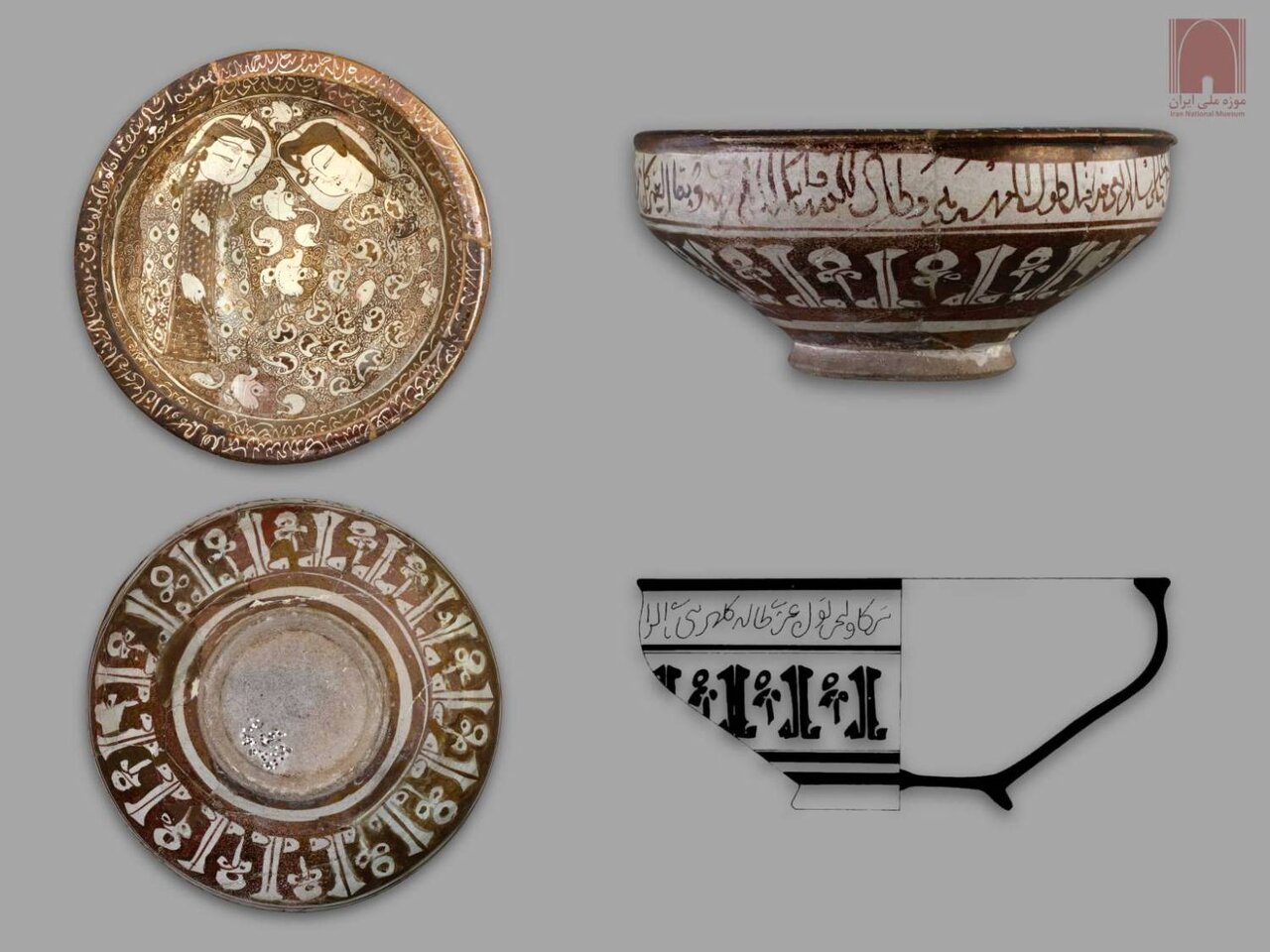
The pictured golden-lustre ceramic bowl, which dates from the 7th century AH (13th–14th century CE), is made of a stone-paste (glass-paste) body. It is deep-bodied, with a flat rim, an elongated profile, and a tall, rounded, concave base. Decorative inscriptions adorn both its interior and exterior surfaces.
Inscribed with Persian and Arabic poetry, the object measures 20 cm in diameter at the mouth and 9 cm in height. It is currently housed at the National Museum of Iran in downtown Tehran.
The primary ornamental focus is at the center: the faces of two ladies facing one another, engaged in conversation. Their heads are tilted toward each other, evoking a sense of emotional intimacy and warmth. The faces are serene and moon-like, painted in a three-quarter view with elongated eyes and uncovered heads.
Around these central figures, the artist has densely packed a rich array of motifs—including birds, flowers and leaves, arabesques (islimi), intertwining lines, and peacock-eye patterns—within the circular space. The background and the patterns on the garments are so intricately interwoven that they merge seamlessly, eliminating any empty space through the sheer density of the ornamentation.
The continuous rotation of the viewer’s eye—from the rim, bearing Persian verses, into the bowl’s interior, to the facing figures, and to the flight of the birds—creates a dynamic interplay between stillness and motion. The harmonious integration of three elements—calligraphy, the human figure, and nature—endows this composition with a unique visual synergy enriched by spiritual depth.
Inside the bowl, two inscriptions in white script against a brown background are visible—one on the rim and another just below it.
The content of the rim inscription consists of the following Persian verses (with some parts reconstructed due to damage):
I brought your love into the core of my soul;
With it, I brought all my sustenance into my being.
At last, I lifted my head above all the world,
Until [I placed your love at the head of] the world.
O you whose counsel is to torment me all year long,
Free from me, yet glad to feed upon my grief—
You said you would not break faith with me again;
Yet this very failure of yours is also upon my neck.
May the Creator of the world keep safe
Wherever the owner of this [bowl] may be.
(The second hemistich is repeated.)
The inscription on the inner edge includes Arabic verses that are repeated from the outer edge (largely lost), in addition to the following Persian quatrain:
[The servant] has become deeply afflicted in soul because of you;
Whether heart or eye, both have turned to blood from your sorrow.
In stony-heartedness, O idol, and in utter dryness,
None is like you— [if an eye has fallen] at your feet in the dust.
Moreover, the bowl’s exterior is likewise adorned with two inscriptions—one in decorative Kufic script and the other in Naskh script—featuring Arabic poetry.
AM
Leave a Comment